Scite — Webinar
From Policy to Practice · 14 May 2026
Policy · Infrastructure · the irreducible human — held together. Pull one and the whole stops holding.
“Treat the patient, not the monitor.
The Challenge
Universities are asked to govern a technology that moves faster than their policy cycles, while their existing detection tools mis-flag non-native English writers and their procurement instincts push them toward a single vendor. Treating AI as a software-purchase problem produces consumers of someone else's judgement. Treating it as a governance problem requires three pillars at once — policy with teeth, infrastructure the institution can actually run, and a deliberate practice for what cannot be outsourced.
The Approach
Hold three pillars together. (i) Write a one-page policy whose load-bearing sentence does the work — Annex A: 'The ultimate responsibility for the work remains with the human.' (ii) Build the infrastructure that lets the policy be enforced rather than admired — BORG, a hybrid platform that keeps Icelandic data on Icelandic energy and routes across four AI vendors so no one of them owns the institution. (iii) Run a one-on-one coaching protocol that surfaces the irreducible part of the participant's own work in their own metaphors. The empirical claims that carry the weight are traceable to resolvable DOIs and had their readings attacked before publication; every number about the platform comes from the running system.
Outcomes
The webinar
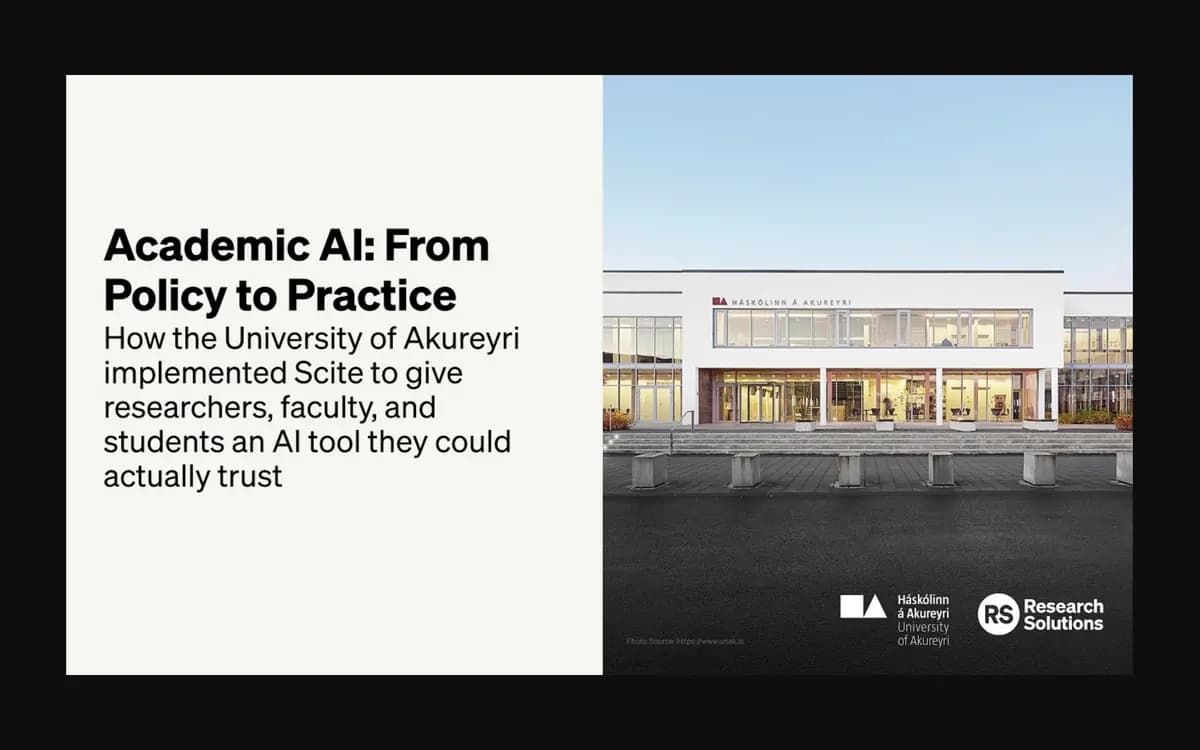
On 14 May 2026 I joined Sean C. Rife and moderator Julia Heesen for a Scite-hosted webinar from Akureyri — Academic AI: From Policy to Practice. Thirty minutes of prepared argument; then the part I always learn most from — the open Q&A. Seventeen questions in sixty minutes.
The talk had one spine. Citation integrity, and academic AI more broadly, is a governance problem — not a software problem. Three pillars carry that argument. Pull any one and the whole stops holding.
Three pillars
- Policy — what the institution commits to. With teeth.
- Infrastructure — what the institution can in fact run and govern on its own terms.
- The irreducible human — what cannot be outsourced: judgement, teaching, body in practice.
Policy — one sentence does the work
The University of Akureyri's Policy on the Responsible Use of Artificial Intelligence, version 2.0, was approved by the University Council on 30 October 2025. I led the drafting and presented it to the Council with Auðbjörg Björnsdóttir; the document itself credits no individual author. The weight of the document rests on a single line in Annex A:
"The ultimate responsibility for the work remains with the human."
That sentence settles the citation-integrity question at institutional scale. Not in the head of the individual. Not in the interpretation of each teacher. A rule infrastructure can be built around.
Infrastructure — BORG, in production
BORG is the platform we built so the policy could be enforced rather than admired. It holds the university's institutional memory on campus, on Icelandic energy, independent of any one vendor. Four AI engines under the hood — Google, Anthropic, OpenAI, and Ollama on our own compute. When a vendor changes price or quality, the platform switches without the user noticing.
About four months. The leverage was method, not headcount: coding agents working through a documented control layer, with a human in command and the build itself recorded in version history. The compression is not a productivity claim. It is a method claim. You can build the AI infrastructure you need with the team you have — if you build the method first. Project page: /en/projects/borg.
The irreducible human
The third leg is the part that cannot be productised. At UNAK it has taken the form of AI Einkaþjálfun — one-on-one coaching. Nine staff members. Each in a single session, 23 to 175 minutes. The claim I have been testing across the nine: you do not need to learn AI; you need to learn to work with it. Eight of the nine articulated that model in their own words inside the session — coded from the session transcripts against a running theme book, one case record per participant, single coder. The ninth held a support model instead, the machine below her rather than beside her; it went into the record as a finding of its own, not a miss. What is still open is durability: the six-week follow-ups are the test.
The finding I keep returning to sits below the productivity numbers. Every participant generated at least two of their own metaphors for what AI is, inside the session. "AI as my next colleague." "A conversation partner — the execution of the ideas is mine." "The university's curling team." No teaching produces that on a slide. That is what irreducibly human work looks like in evidence.
The questions — what the room asked back
Almost every one of the seventeen questions was a variation on the same instinct — what should I get, what should I copy, what tool will solve this for me? The answer that came back, line after line, was a method, not a product.
Can we get access to BORG? — from the audience
The short answer is no — and that is part of the value. The longer one: do not buy this; build your own. An institution that consumes BORG instead of building BORG becomes a tenant in someone else's governance. The method is what is shareable — not the running system.
What would you advise a small university taking its first steps? — from the audience
The method is more repeatable than the numbers. You don't need ten people. You need two with the right method — one principal plus a support. Key point: one person who has built, broken, and fixed — not a consultant who has read. Markdown-led governance plus AI inside a human-set frame plus an auditable git history scales sublinearly with team size.
How should I think about AI-detection tools? — from the audience
The peer-reviewed evidence is unambiguous. Liang et al. (2023) found that the majority of TOEFL essays by non-native English writers are mis-flagged as AI-generated, with near-zero false positives on US-born students. Weber-Wulff et al. (2023) tested fourteen tools and found them "no better than random" on paraphrased text. Using detection as the primary check on academic integrity is not just inaccurate; it is a discrimination finding. Policy and teaching do the work detection can't.
Can policies keep up with the speed of the technology? — from the audience
Documents can't keep pace with weekly model updates. So write principles with teeth — not procedural specs. "AI may not be cited as a source" survives five years. "Best prompt template for Claude 3.5" survives three weeks. Policies that endure are laws in one paragraph, not books in thirteen.
Why not just one model? — from the audience
We use four — Google, Anthropic, OpenAI, and Ollama on our own compute. When a vendor changes price or quality, the system switches itself. Same question, same answer — and the university is never bound to one contract. Cross-checking models also surfaces biases that any single model would hide. That is part of the sovereignty story, not a technical flourish.
The evidence floor
Five anchor citations carry the empirical weight of the talk. Each is a resolvable DOI; each survived an adversarial verification pass before going on the page.
- Bastani, Bastani & Sungu (2025). Generative AI without guardrails can harm learning. PNAS 122(38). doi.org/10.1073/pnas.2422633122 — and the published August 2025 correction. Unguardrailed GPT-4 access raised practice scores by 48% and erased a 17% chunk of learning when access was removed. A teacher-prompted variant largely recovered the gap. Implementation design — not the model — decides whether skill builds or erodes.
- Weber-Wulff et al. (2023) — detection tools "no better than random" on paraphrased text.
- Liang et al. (2023) — detection tools mis-flag non-native English writers as AI; near-zero false positives on US-born students.
- Gravel, D'Amours-Gravel & Osmanlliu (2023) — the medical-citation hallucination case.
- Magesh et al. (2025) — the legal-citation hallucination case.
Scite earns its place in this argument on the retraction-blindness finding. A retracted paper does not stop being cited the moment it is retracted. A platform that surfaces retraction status on the citing graph turns a one-shot question — is this paper still good? — into a structural one — what does the field still think, and on what evidence?
"I am sure that the speakers can elaborate further but I have to say, this was excellent. … Thanks so much Magnús, and I'm hoping that you'll come back another time, because, it was just so insightful — and also fun. … Just very, very inspiring to see what is actually possible."
Closing
One operator with a $360-a-year subscription stack, markdown-led governance, and prior training built a full university platform in 54 working days. Universities certify almost entirely on the basis of production — and production can now be made for a fraction of a cent. There is real shaping behind that production, but it is a different kind of shaping than the one the institution certifies. The honest question is no longer "what is our AI policy?" It is the ambulance maxim raised one notch: treat the patient, not the monitor. How do we certify the human in the seat?
The acceleration is real. The irreducible human stays human.
Recording. The full webinar recording is forthcoming via Scite — link will be added to this page when published.
Technology Stack
People
Resources
Lessons Learned
- Policy without infrastructure is a leaflet. Infrastructure without policy is unaccountable. Neither without the irreducible human is the un-guardrailed condition, where skill erodes automatically.
- The retraction question is structural, not anecdotal. A citation graph that surfaces retraction notices turns one-shot fact-checking into ongoing integrity.
- Detection tools are not the right primary instrument for academic integrity — Liang's TOEFL evidence makes that a discrimination finding, not a precision finding. Policy and teaching do the work detection cannot.
- Method is what compounds; headcount is not. The compression is not productivity theatre; it is the result of pushing decisions up to markdown governance and keeping the models inside the human-set frame.
- The irreducible human is the part of the work that cannot be productised — and it is exactly the part universities currently fail to certify. Treat the patient, not the monitor.
Related Projects
View all projects →
BORG
The University of Akureyri's hybrid AI platform, combining commercial models with on-premise infrastructure so sensitive data stays on the university network.
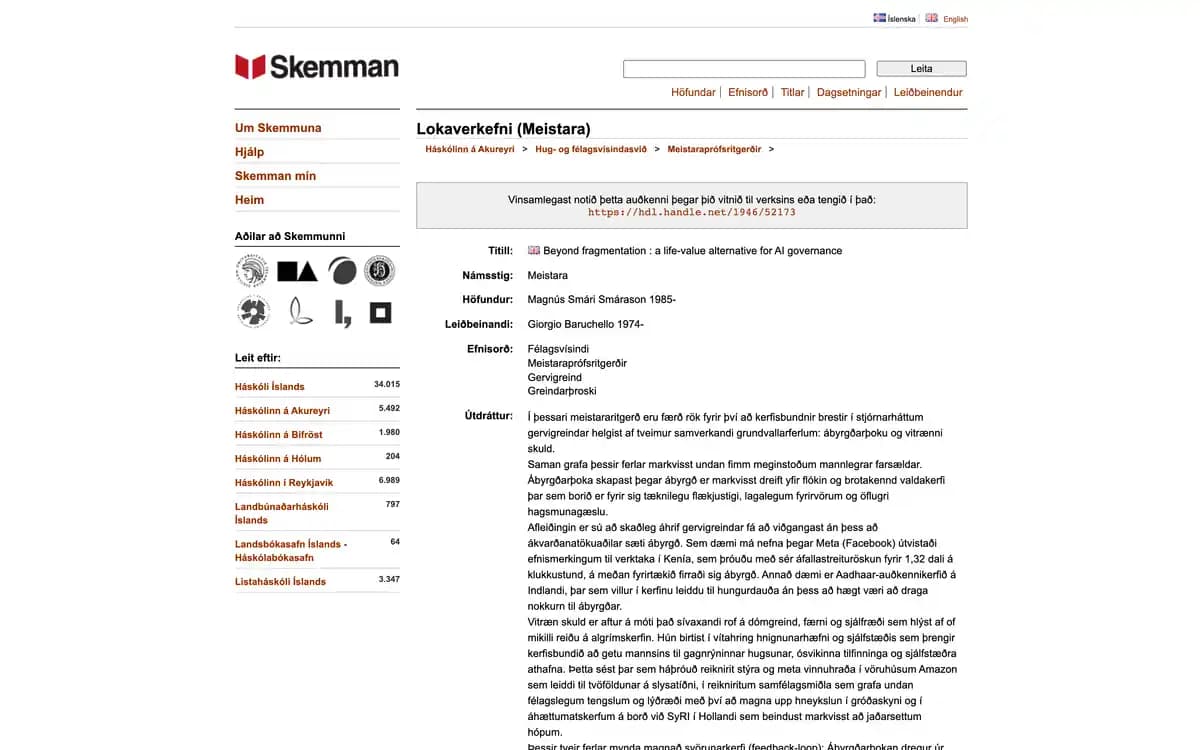
Beyond Fragmentation
Why AI governance fails by design — and why the harms this thesis documents result from institutional choices rather than technological inevitability.
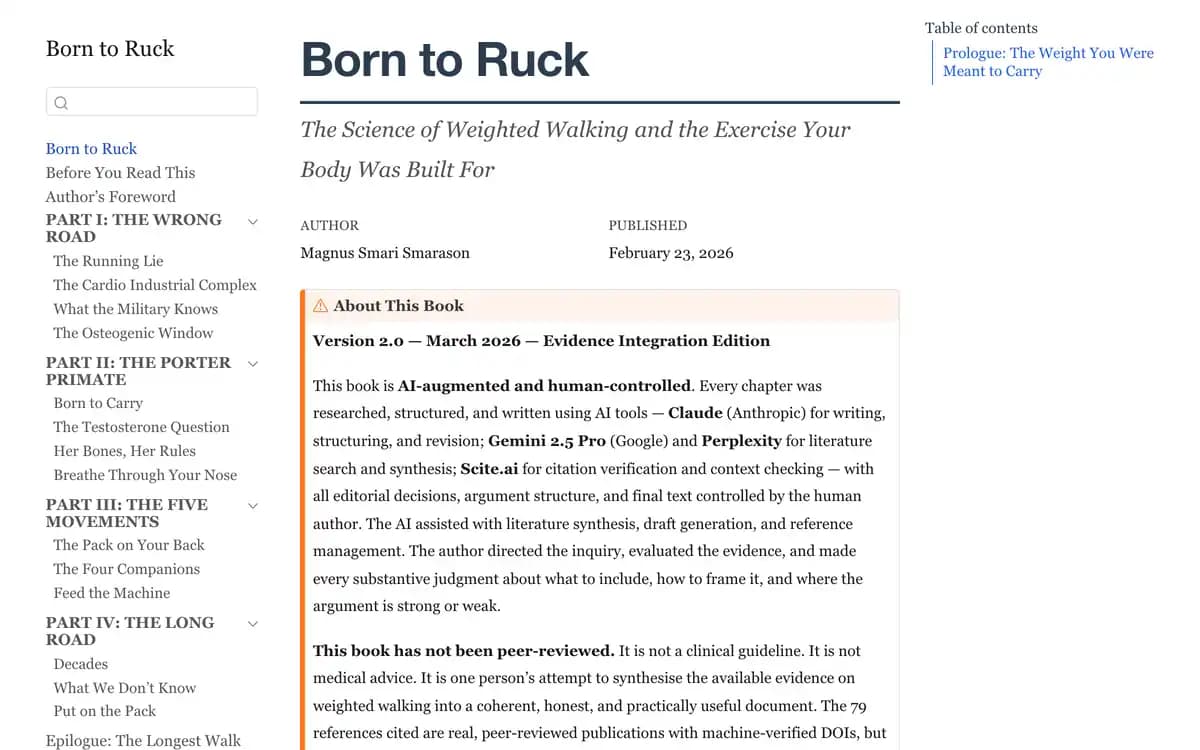
Born to Ruck
Open-source science book on rucking — 14 chapters, 86 DOI-verified citations, and the honest acknowledgment that the most complete exercise your body can do requires a backpack and a closed mouth.